Lightweight aluminium strength for machinery and robotics in harsh environments
High strength, wear resistance and reliable weldability for lighter aluminium structural parts in industrial equipment and robots operating in harsh, vibration-heavy environments.
Description
When industrial equipment needs to perform reliably under harsh conditions, every detail matters: weight, strength, corrosion resistance, repairability and long-term performance. AMAG CrossAlloy.57 is an advanced aluminium alloy designed for highly loaded structural components in industrial machinery, with clear potential for mobile, autonomous and battery-electric robotics.
Developed for environments exposed to vibration, impact, moisture, dirt and chemical stress, CrossAlloy.57 enables lighter, stronger and more durable components for demanding industrial, agricultural, mining and high-performance applications. It brings 7xxx-level strength with better weldability and corrosion resistance: a weldable alternative to 7075 for structural parts.
The CrossAlloy.57 advantage
- High strength-to-weight performance : Lighter frames, arms, housings and protective structures without compromising load-bearing performance.
- Resistance to harsh operating conditions : Withstands moisture, dirt, mud, vibration and chemically demanding operating conditions.
- Designed for long service life : Improved fatigue resistance supports long service life under repetitive load cycles and dynamic stress.
- Good joining and weldability : Good weldability and joining enable robust connections, modular designs and service-friendly repair concepts.
- Lifecycle cost potential : Reduced weight can improve range, payload, energy efficiency and overall system lifetime.
Chemical Composition
The performance rests on the crossover chemistry: a high-magnesium 5xxx base made age-hardenable, hardening via the T-phase instead of the η-phase. Current internal specification limits and typical measured values are shown below.
| wt-% | Si | Fe | Cu | Mn | Mg | Zn | Cr | Ti | Zr |
|---|---|---|---|---|---|---|---|---|---|
| Min | – | – | 0.40 | 0.20 | 4.30 | 3.20 | – | – | – |
| Max | 0.40 | 0.40 | 0.70 | 0.45 | 4.90 | 3.60 | 0.20 | 0.15 | 0.10 |
| Typical | 0.15 | 0.21 | 0.50 | 0.32 | 4.65 | 3.43 | 0.06 | 0.02 | < 0.01 |
Remainder Al; other elements ≤ 0.10 each / ≤ 0.20 total.
Mechanical Behavior
For machine frames, arms and equipment, higher strength means less material and less moving mass. CrossAlloy.57 reaches Rp0.2 values up to 480 MPa (T6): far above general-purpose 6061-T6 (~276 MPa) and marine-grade 5083 (~215 MPa), and into 7075-T651 territory (~500 MPa), yet weldable and more corrosion-resistant than 7075.
Typical values are shown below; establishing customer specifications is feasible upon request.
Strip / sheet 1.0 – < 6.0 mm
| Property | T6 | T76 | T73 |
|---|---|---|---|
| Rp0.2 (MPa) | 450–480 | 380–410 | 310–340 |
| Rm (MPa) | 510–540 | 470–500 | 430–460 |
| A (%) | 9–12 | 10–13 | 11–14 |
Plate 6.0 – 75.0 mm
| Property | T451 | T6151 | T651 | T7651 | T7351 |
|---|---|---|---|---|---|
| Rp0.2 (MPa) | 270–300 | 370–390 | 440–470 | 370–400 | 300–330 |
| Rm (MPa) | 440–470 | 470–490 | 510–540 | 470–500 | 430–460 |
| A (%) | 20–25 | 12–16 | 8–12 | 9–13 | 11–14 |
Reference alloys in the field for comparison:
| Property | 6061 (T651) | 5083 (H116) | 7075 (T651) | 7075 (T7351) |
|---|---|---|---|---|
| Rp0.2 min (MPa) | 240 | 200–215 | 420–475 | 340–390 |
| Rm min (MPa) | 290 | 285–305 | 495–545 | 440–475 |
| A min (%) | 6–10 | 8–12 | 4–8 | 5–8 |
Minimum values according to EN 485-2, aggregated over the thickness span shown for CrossAlloy.57.
Bendability
Formed sheet parts such as covers, guards and brackets need reliable, crack-free bends. The naturally aged T451 plate bends readily; peak-aged T6 and T651 need a larger radius.
EN ISO 7438: Minimum bending radius to reach 90° without cracking, axis in rolling direction
| Thickness t | CA57 (T6) | CA57 (T451) | CA57 (T651) | 6061 (T6) | 7075 (T651) | 5083 (H116) |
|---|---|---|---|---|---|---|
| 0.5–1.5 mm | 2.0 t | – | – | 2.5 t | 5.5 t | – |
| 1.5–3.0 mm | 3.0 t | – | – | 3.5 t | 6.5 t | 2.0 t |
| 3.0–6.0 mm | – | 2.0 t | 3.0 t | 4.0 t | 8.0 t | 2.5 t |
Reference values according to EN 485-2 (minimum bending radius for 90° bending, informative).
Fracture Toughness
Impact and crack resistance matter for parts that take shock and vibration. The naturally-aged T451 is toughest and peak-aged T651 the least; the overaged T7651 sits between the two, and a batch composition optimized for toughness lifts it further.
ASTM E399: Plane-strain fracture toughness, compact-tension (CT) geometry
| Material | KIc T-L (MPa√m) | KIc L-T (MPa√m) | Rm (MPa) |
|---|---|---|---|
| CrossAlloy.57-T451 | 34–38 | 39–43 | ~430 |
| CrossAlloy.57-T651 | 18–22 | 25–30 | ~520 |
| CrossAlloy.57-T7651 | 21–25 | 27–33 | ~500 |
| CrossAlloy.57-T76511) | 28–30 | 39–41 | ~500 |
| 7075-T6512) | 24 (20–30) | 29 (22–33) | ~550 |
| 7075-T76512) | 25 (22–31) | 32 (24–47) | ~525 |
| 7075-T73512) | 30 (23–52) | 33 (27–40) | ~500 |
1) Batch composition optimized for high fracture toughness.
2) MMPDS-2025, Table 3.1.2.1.4 (plate): average of the reported data, min–max range in brackets.
Fatigue
Frames, arms and moving structures see millions of load cycles, so fatigue life often decides the service life of a machine. CrossAlloy.57 was assessed against aerospace requirements, the most demanding benchmark available for aluminium: it tracks typical 7xxx aerospace alloys and clearly outperforms 2024, an assessment confirmed by a major aircraft OEM. The chart overlays CrossAlloy.57 test points on the aerospace handbook reference bands according to AIMS, MMPDS and HSB.
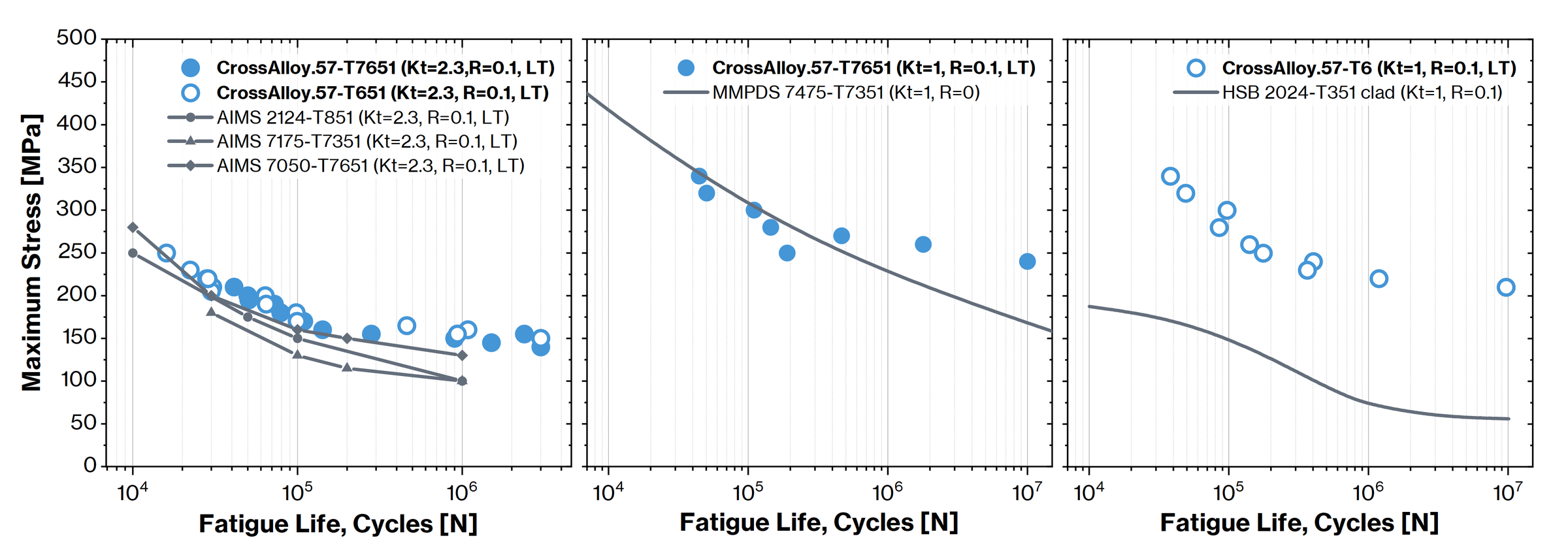
CrossAlloy.57 fatigue test points against aerospace reference data: notched (Kt=2.3) vs. AIMS 2124-T851, 7175-T7351 and 7050-T7651; unnotched (Kt=1) vs. MMPDS 7475-T7351 and HSB 2024-T351 clad.
Machining
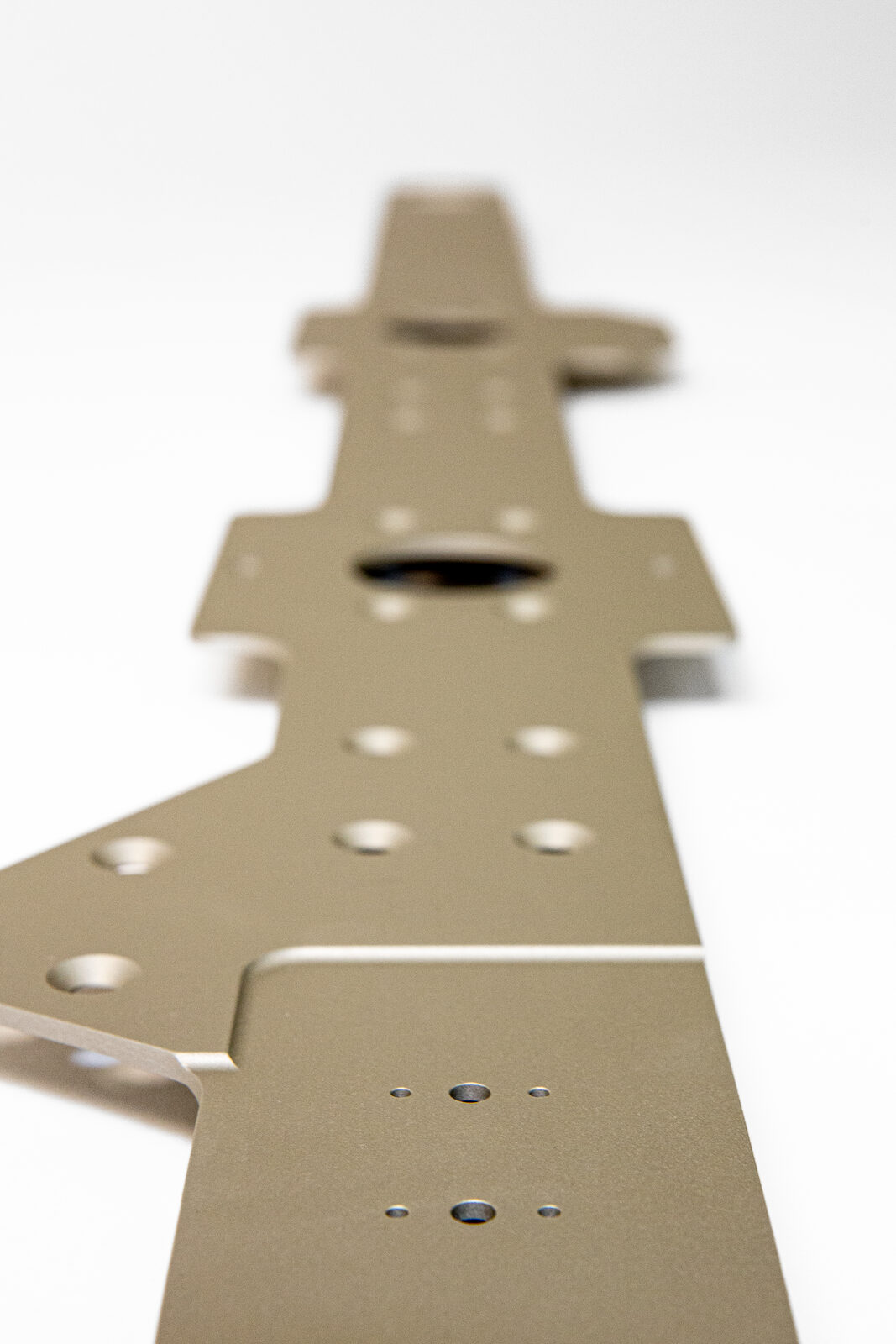
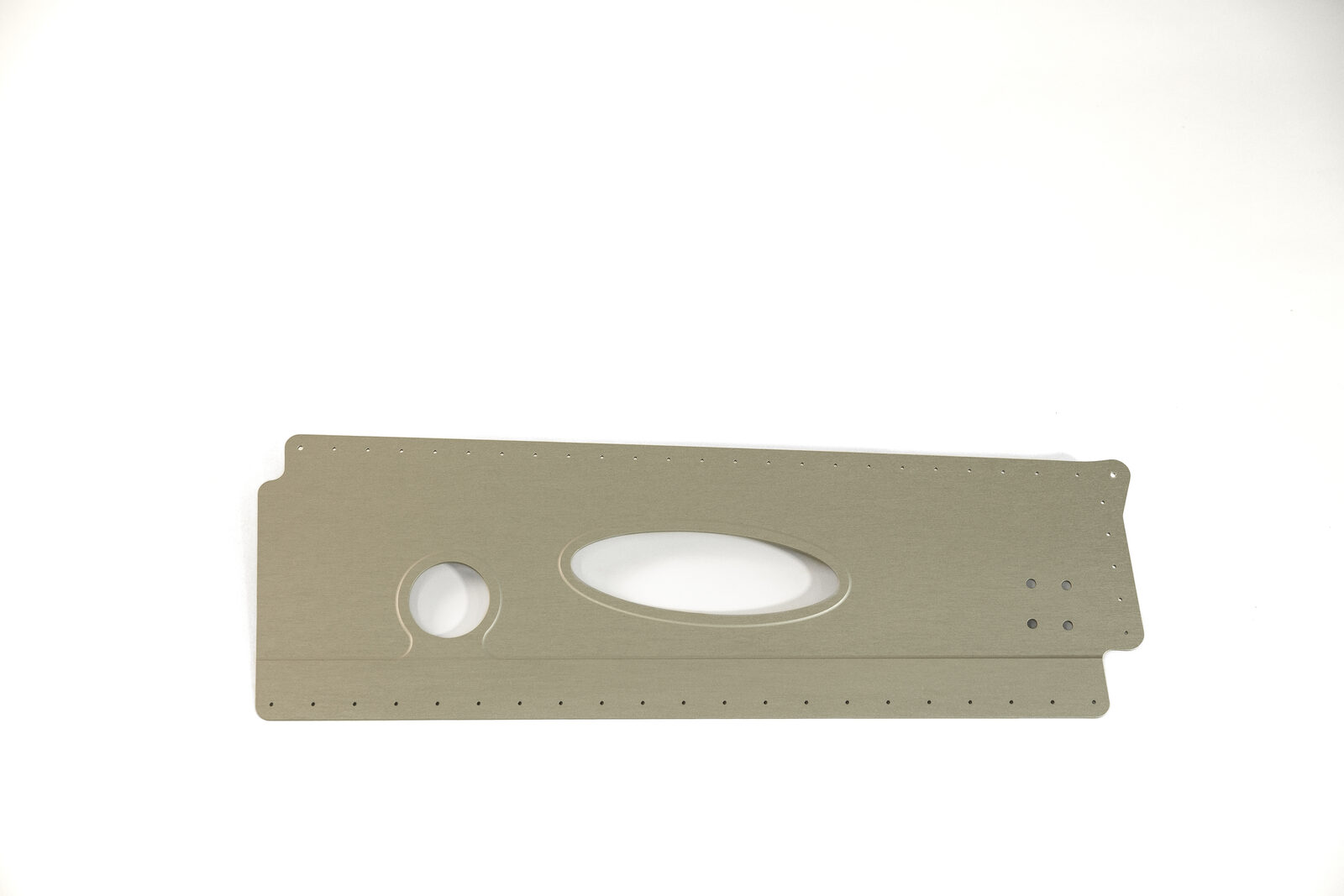
Machined housings and fittings need dimensional stability. CrossAlloy.57 machines with exceptionally low distortion due to minimal residual stress and without hot spots, enabling uniform in-service performance.
Corrosion
Equipment runs in dust, moisture and chemically aggressive environments. Corrosion is tunable by temper and clearly better than peak-aged 7075; the 5xxx alloys (5083) remain the corrosion benchmark.
| Condition | ASTM G67 (NAMLT) | ASTM G110 (IGC acc. 2xxx/7xxx) | ASTM G44/G47 (SCC) |
|---|---|---|---|
| T451 | < 5 mg/cm³ | < 100 µm | – |
| T6151 | < 10 mg/cm³ | < 100 µm | NA |
| T651 / T61) | < 20 mg/cm³ | < 100 µm | < 100 h |
| T7651 / T761) | < 30 mg/cm³ | < 100 µm | NA |
| T7351 / T731) | < 15 mg/cm³ | < 100 µm | > 480 h |
NA = not yet available; the required test duration has not been reached. Detailed SCC investigations are ongoing.
1) Conditions without cold work (T6, T76, T73) not separately evaluated; similar performance expected based on historical data for standard alloys.
Anodizing
Housings, covers, guides and guards are typically hard-anodized for wear and corrosion protection. CrossAlloy.57 anodizes without process adaptation: thin sheet develops a homogeneous, streak-free layer. On thick plate the grain structure becomes more pronounced towards mid-thickness, which is normal for high-strength wrought alloys and is seen in the same way on 7xxx grades. For machined parts the layer should be qualified on the final geometry, because the visible structure follows the depth of cut.
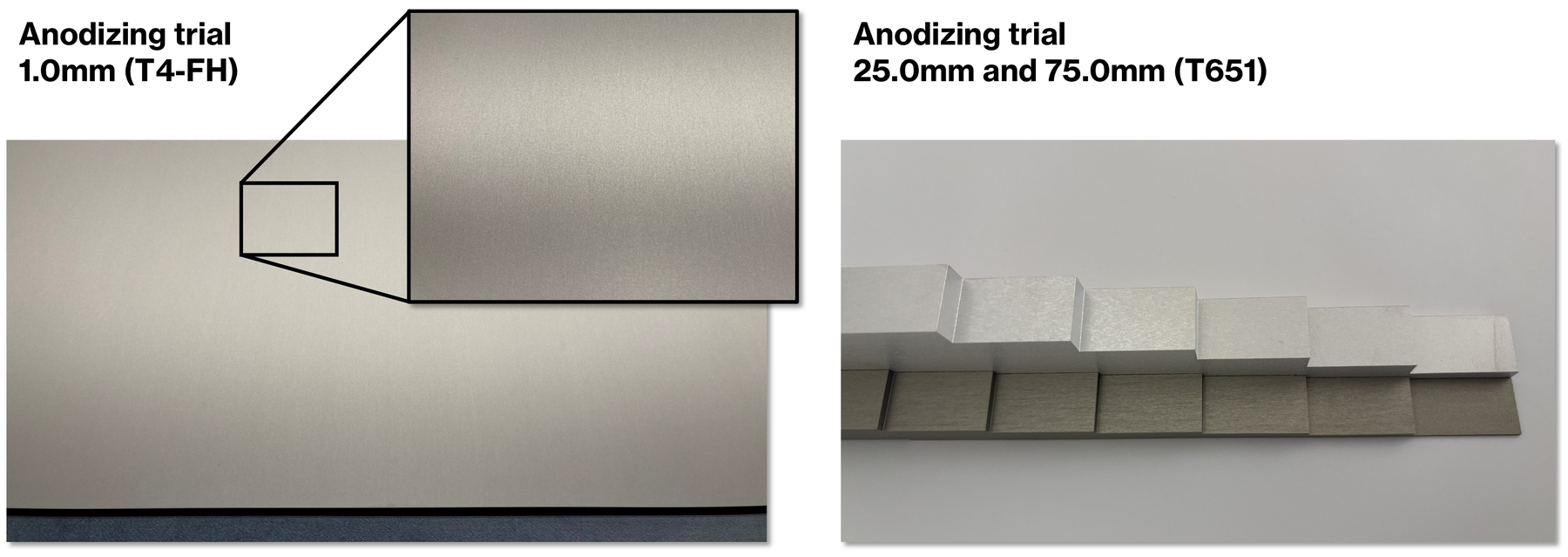
Anodizing trials: 1.0 mm sheet with a homogeneous, streak-free surface, and step samples from 25.0 mm (pickled and clear-anodized) and 75.0 mm plate (pickled only).
Wear
Structural parts run in abrasive dust, mud and grit. Wear resistance was assessed according to ASTM G65: in the standardized test CrossAlloy.57 performs nearly identical to 7020-T651 and 5083-H34. In-field testing at several sampling customers (wear plates on tipper bodies), however, shows clearly better performance than 5083 or 5456. Quantitative in-field wear data is being collected in ongoing customer trials.
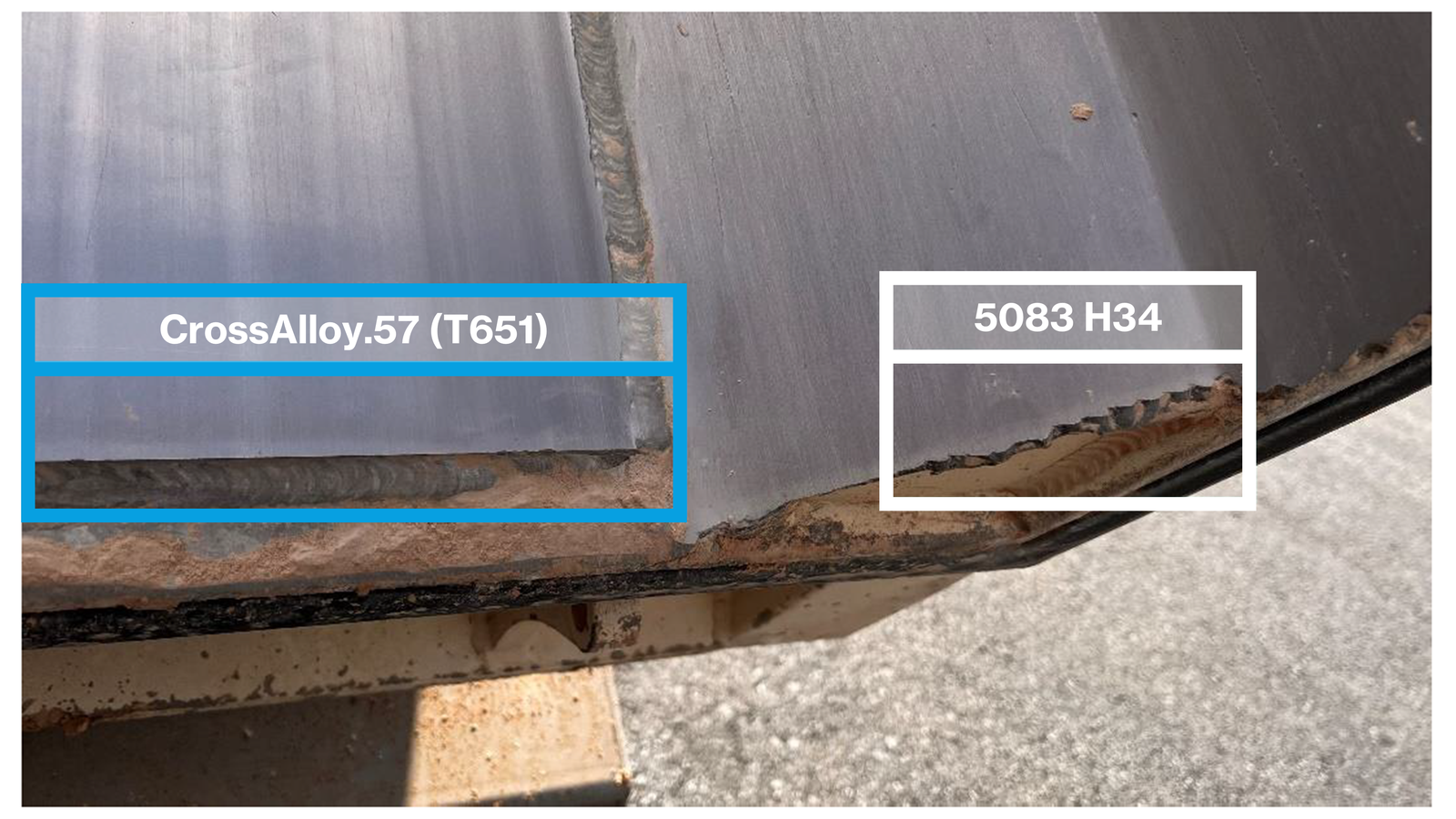
In-field wear comparison on tipper-body plates: CrossAlloy.57 (T651) shows markedly less edge erosion than 5083-H34 after the same service exposure.
Joining
Frames and housings are often welded assemblies. CrossAlloy.57 is compatible with friction stir welding and behaves much like 5xxx alloys for arc welding; GMAW/GTAW were tested on 6/10/25/38.1 mm with no hot cracking. Weld-performance figures are indicative and require validation for specific use cases.
| Process | Result (T651) | Note |
|---|---|---|
| FSW | > 75 % Rm retained | joint vs. base material, confirmed on 2, 3 and 6 mm |
| GMAW/GTAW | > 65 % Rm; up to 85 % Rm | 85 % with matching filler wire + post-weld heat treatment |
Physical Properties
| Property | min–max | mean |
|---|---|---|
| Density ρ (g/cm³) | 2.71–2.72 | 2.71 |
| Young's modulus E (GPa) | 70.3–73.0 | 71.7 |
| Shear modulus G (GPa) | 26.3–27.5 | 26.6 |
Potential use cases for CrossAlloy.57
Proposed applications are indicative and derived from cross-correlation between available material data and market research. They reflect where CrossAlloy.57 could add value from our perspective; given the limited information available to us, actual suitability is application-specific and is confirmed in cooperation with partners.
Agricultural robots
Lightweight chassis, frames, sensor carriers and modular interfaces for precise and robust field robotics.
Mining robots
Protective frames, housings and structural components for dusty, humid and vibration-intensive underground environments.
Lightweight housings and structural parts
Drive, gearbox and structural housings requiring high stiffness, low weight and long operating life.
Available Dimensions
| Thickness | Max. width (mm) | Max. length (mm) |
|---|---|---|
| 1.0–2.0 mm | ||
| T6 / T76 / T73 | 1500 | 6000 |
| 2.0–6.0 mm | ||
| T6 / T76 / T73 | 1500 | 6000 |
| 6.0–12.0 mm | ||
| all Tx51 tempers | 1500 | 6000 |
| 12.0–150.0 mm | ||
| all Tx51 tempers | 1500 | 6500 |
Conservative assessment based on prototype production and limited number of lots. Additional dimensions available upon request.