Lightweight aluminium performance for rail and special vehicles built to last
High strength, fatigue resistance and corrosion protection for underframes, beams, panels and structural bodies in rail and special vehicles that must perform for decades.
Description
Modern rail and special vehicles must be lighter, more efficient and built for decades of reliable operation. From high-speed trains to regional rail platforms, tippers and special-purpose vehicles, structural components need to combine high strength, fatigue resistance, corrosion protection and excellent manufacturability.
AMAG CrossAlloy.57 is designed for lightweight aluminium structures in demanding rail and special-vehicle applications. The alloy enables durable, weight-optimized components that support lower energy consumption, reduced lifecycle costs and efficient large-scale production. The verified material and weld data comes from the commercial-vehicle context; rail and special-vehicle use are researched potentials pursued with partners.
The CrossAlloy.57 advantage
- High strength-to-weight performance : Lighter underframes, beams and structural parts without compromising load-bearing capability.
- Designed for long service life : Improved fatigue resistance supports durable structures exposed to vibration and decades of operation.
- Good joining and weldability : Robust welded assemblies, efficient production and reliable integration into large rail vehicle structures.
- Corrosion resistance for outdoor environments : Long-term durability of structural components exposed to weather, moisture and pollutants.
- Lifecycle cost potential : Weight reduction can lower energy consumption, brake wear and maintenance across the vehicle lifetime.
Chemical Composition
The performance rests on the crossover chemistry: a high-magnesium 5xxx base made age-hardenable, hardening via the T-phase instead of the η-phase. Current internal specification limits and typical measured values are shown below.
| wt-% | Si | Fe | Cu | Mn | Mg | Zn | Cr | Ti | Zr |
|---|---|---|---|---|---|---|---|---|---|
| Min | – | – | 0.40 | 0.20 | 4.30 | 3.20 | – | – | – |
| Max | 0.40 | 0.40 | 0.70 | 0.45 | 4.90 | 3.60 | 0.20 | 0.15 | 0.10 |
| Typical | 0.15 | 0.21 | 0.50 | 0.32 | 4.65 | 3.43 | 0.06 | 0.02 | < 0.01 |
Remainder Al; other elements ≤ 0.10 each / ≤ 0.20 total.
Mechanical Behavior
Underframes, beams and vehicle structures carry crash and fatigue loads for decades. CrossAlloy.57 reaches Rp0.2 values up to 480 MPa (T6): above the extruded 6xxx car-body alloys (6082/6061, ~260–280 MPa) and marine plate 5083 (~215 MPa), and clearly above the weldable rail-structure class 7020-T6 (~280 MPa).
For HFQ/SPF processed parts the service behavior can be tuned within the provided range by modification of processing and heat-treatment parameters to accommodate a use-case-specific performance profile.
Typical values are shown below; establishing customer specifications is feasible upon request.
Strip / sheet 1.0 – < 6.0 mm
| Property | T4-FH1) | after HFQ/SPF | T6 | T76 | T73 |
|---|---|---|---|---|---|
| Rp0.2 (MPa) | 260–310 | 255–400 | 450–480 | 380–410 | 310–340 |
| Rm (MPa) | 430–470 | 440–500 | 510–540 | 470–500 | 430–460 |
| A (%) | 18–23 | 11–18 | 9–12 | 10–13 | 11–14 |
1) FH: Pre-treated after solutionizing and quenching to ensure optimal grain structure, limited natural aging and fast hardening during subsequent aging
Plate 6.0 – 10.0 mm
| Property | T451 | T6151 | T651 | T7651 | T7351 |
|---|---|---|---|---|---|
| Rp0.2 (MPa) | 270–300 | 370–390 | 440–470 | 370–400 | 300–330 |
| Rm (MPa) | 440–470 | 470–490 | 510–540 | 470–500 | 430–460 |
| A (%) | 20–25 | 12–16 | 8–12 | 9–13 | 11–14 |
Reference alloys in the field for comparison:
| Property | 6082 (T6) | 5083 (O/H111) | 5083 (H116) | 7020 (T651) |
|---|---|---|---|---|
| Rp0.2 min (MPa) | 255–260 | 115–125 | 215 | 280 |
| Rm min (MPa) | 300–310 | 270–275 | 305 | 350 |
| A min (%) | 6–10 | 12–16 | 8–12 | 7–10 |
Minimum values according to EN 485-2, aggregated over the thickness span shown for CrossAlloy.57.
Bendability
Formed profiles and panels need reliable bends across the whole gauge range. T4-FH bends readily but requires subsequent heat treatment to establish preferential in-use conditions; peak-aged T6/T651 needs a larger radius.
EN ISO 7438: Minimum bending radius to reach 90° without cracking, axis in rolling direction
| Thickness t | CA57 (T4-FH) | CA57 (T6) | CA57 (T451) | CA57 (T651) | 5083 (O/H111) | 6082 (T6) | 7020 (T651) |
|---|---|---|---|---|---|---|---|
| 0.5–1.5 mm | 1.5 t | 2.0 t | – | – | 1.0 t | 2.5 t | 3.5 t |
| 1.5–3.0 mm | 2.5 t | 3.0 t | – | – | 1.0 t | 3.5 t | 4.0 t |
| 3.0–6.0 mm | – | – | 2.0 t | 3.0 t | 1.5 t | 4.5 t | 5.5 t |
Reference values according to EN 485-2 (minimum bending radius for 90° bending, informative).
Fracture Toughness
Impact and crack resistance matter for parts that take shock and vibration. The naturally-aged T451 is toughest and peak-aged T651 the least; the overaged T7651 sits between the two, and a batch composition optimized for toughness lifts it further.
ASTM E399: Plane-strain fracture toughness, compact-tension (CT) geometry
| Material | KIc T-L (MPa√m) | KIc L-T (MPa√m) | Rm (MPa) |
|---|---|---|---|
| CrossAlloy.57-T451 | 34–38 | 39–43 | ~430 |
| CrossAlloy.57-T651 | 18–22 | 25–30 | ~520 |
| CrossAlloy.57-T7651 | 21–25 | 27–33 | ~500 |
| CrossAlloy.57-T76511) | 28–30 | 39–41 | ~500 |
| 7075-T6512) | 24 (20–30) | 29 (22–33) | ~550 |
| 7075-T76512) | 25 (22–31) | 32 (24–47) | ~525 |
| 7075-T73512) | 30 (23–52) | 33 (27–40) | ~500 |
1) Batch composition optimized for high fracture toughness.
2) MMPDS-2025, Table 3.1.2.1.4 (plate): average of the reported data, min–max range in brackets.
Forming & Machining
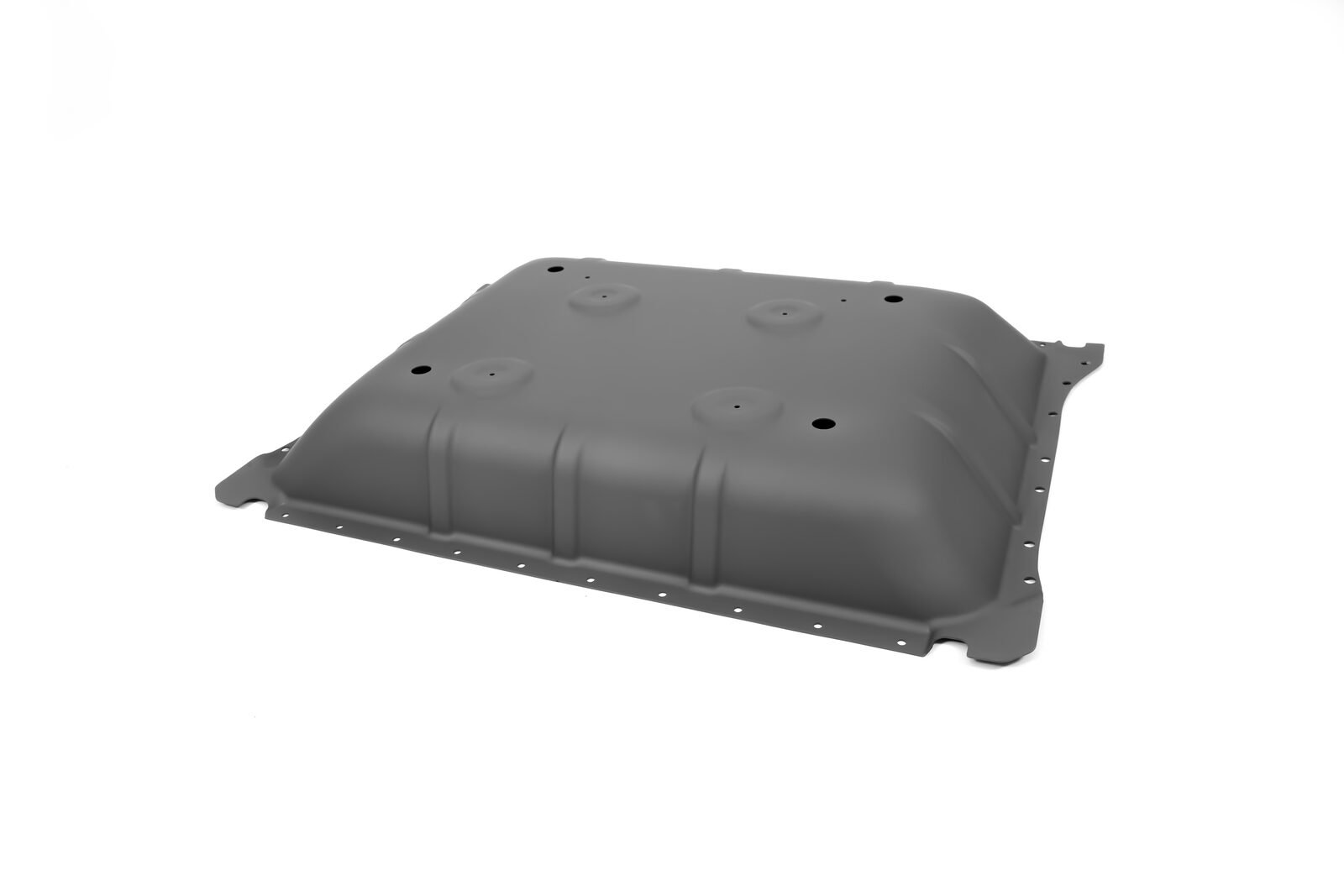
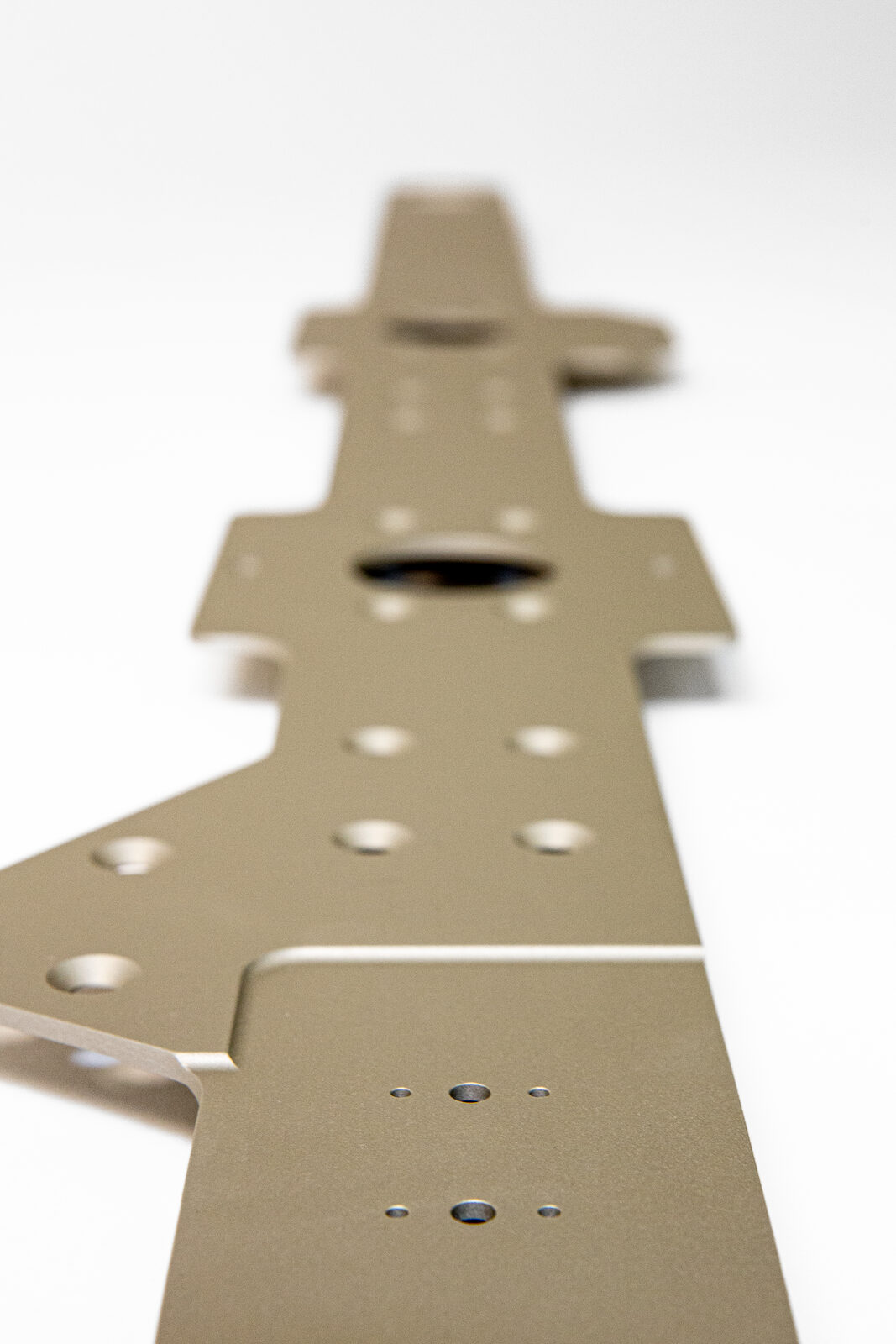
Rail and special-vehicle structures combine formed and machined parts: outer skins, roof segments and side panels are formed from sheet, while interfaces, brackets and fittings are machined. Large aerodynamic outer skins such as train noses and side panels are complex, curved parts, today often formed from 5083-O; warm formability at a markedly higher strength level lets CrossAlloy.57 target such panels with fewer reinforcements. The warm-forming routes (SPF for the most complex panels, HFQ for high-strength formed parts) complement cold forming of thin sheet. CrossAlloy.57 machines with exceptionally low distortion due to minimal residual stress and without hot spots, enabling uniform in-service performance. Quantitative formability figures beyond bending are not yet available.
Corrosion
Vehicles face road salt, weather and, for tanks, aggressive media; that is why marine-grade 5083/5456 dominate today. CrossAlloy.57 targets a comparable corrosion profile at markedly higher strength, tunable by temper.
| Condition | ASTM G67 (NAMLT) | ASTM G110 (IGC acc. 2xxx/7xxx) | ASTM G44/G47 (SCC) |
|---|---|---|---|
| T451 / T4-FH1) | < 5 mg/cm³ | < 100 µm | – |
| T6151 | < 10 mg/cm³ | < 100 µm | NA |
| T651 / T61) | < 20 mg/cm³ | < 100 µm | < 100 h |
| T7651 / T761) | < 30 mg/cm³ | < 100 µm | NA |
| T7351 / T731) | < 15 mg/cm³ | < 100 µm | > 480 h |
NA = not yet available; the required test duration has not been reached. Detailed SCC investigations are ongoing.
1) Conditions without cold work (T4-FH, T6, T76, T73) not separately evaluated; similar performance expected based on historical data for standard alloys.
Anodizing
Anodizing is used on rail vehicles for exterior panels and add-on parts and, on special-vehicle bodies, as a durable corrosion protection. CrossAlloy.57 anodizes without process adaptation: thin sheet in T4-FH develops a homogeneous, streak-free layer. On thick plate the grain structure becomes more pronounced towards mid-thickness, which is normal for high-strength wrought alloys and is seen in the same way on 7xxx grades. For visible surfaces the layer should be qualified on the final geometry.
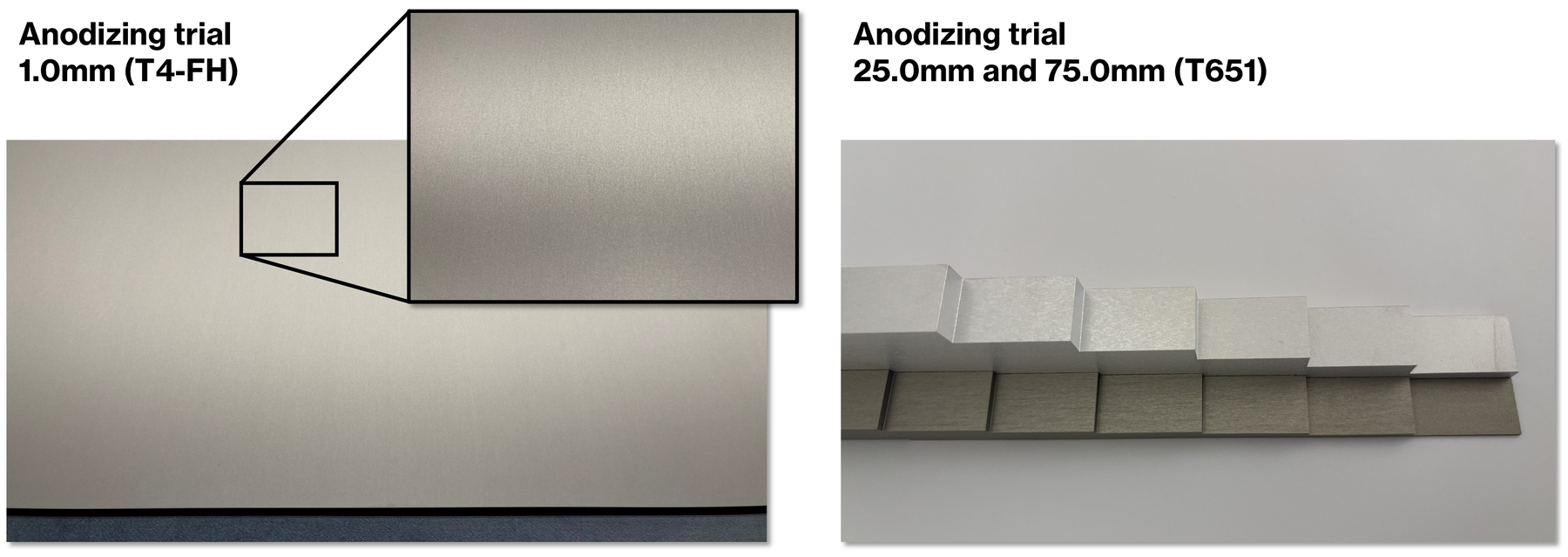
Anodizing trials: 1.0 mm sheet in T4-FH with a homogeneous, streak-free surface, and step samples from 25.0 mm (pickled and clear-anodized) and 75.0 mm plate (pickled only).
Wear
Wear plates and tipper bodies run in abrasive dust, mud and grit. Wear resistance was assessed according to ASTM G65: in the standardized test CrossAlloy.57 performs nearly identical to 7020-T651 and 5083-H34. In-field testing at several sampling customers (wear plates on tipper bodies), however, shows clearly better performance than 5083 or 5456. Quantitative in-field wear data is being collected in ongoing customer trials.
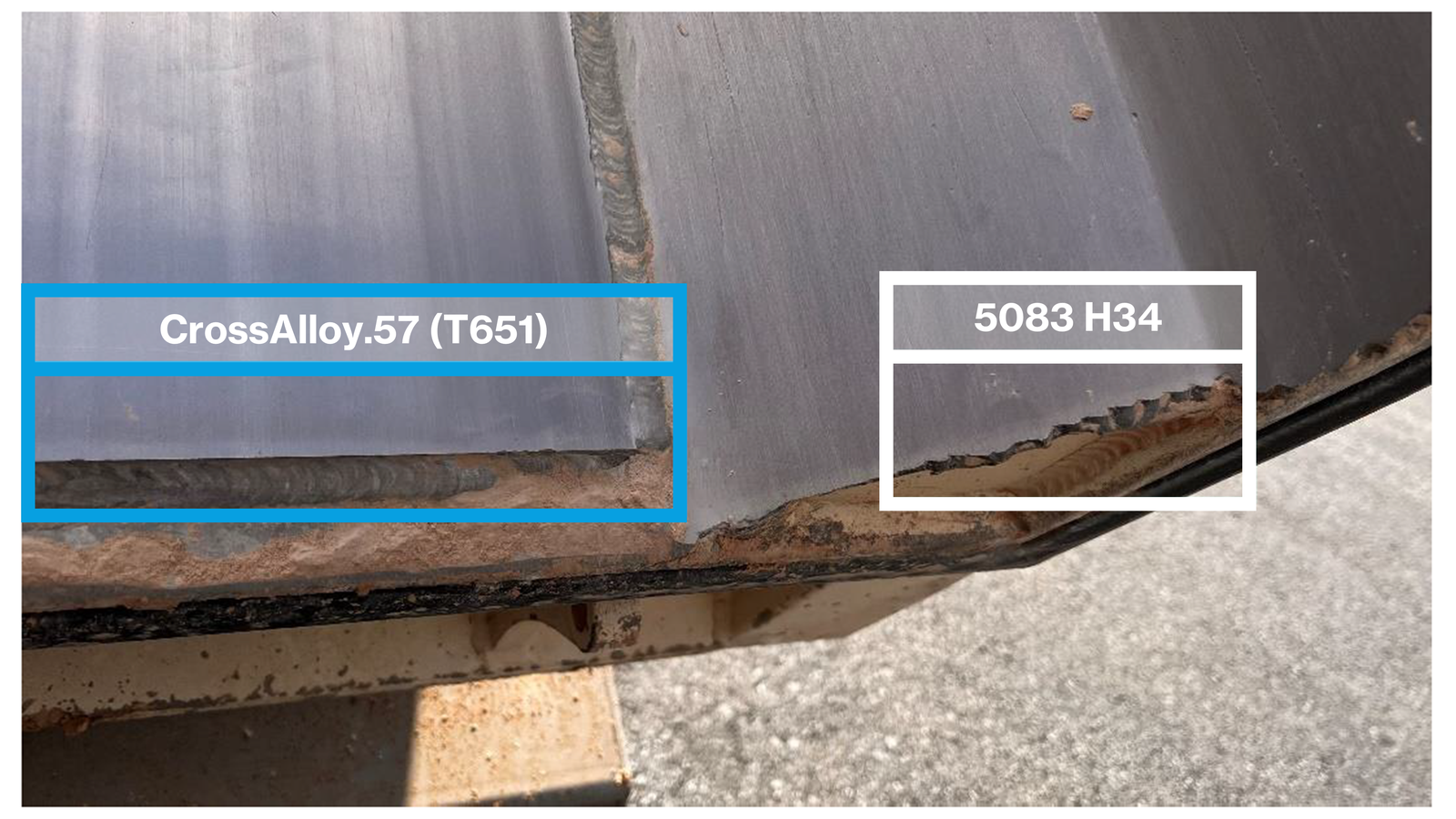
In-field wear comparison on tipper-body plates: CrossAlloy.57 (T651) shows markedly less edge erosion than 5083-H34 after the same service exposure.
Joining
Car bodies, vehicle structures and tanks are large welded assemblies, so weld strength and distortion control decide manufacturability. CrossAlloy.57 is compatible with friction stir welding and behaves much like 5xxx alloys for arc welding; GMAW/GTAW were tested on 6/10/25/38.1 mm with no hot cracking. Weld-performance figures are indicative and require validation for specific use cases.
| Process | Result (T651) | Note |
|---|---|---|
| FSW | > 75 % Rm retained | joint vs. base material, confirmed on 2, 3 and 6 mm |
| GMAW/GTAW | > 65 % Rm; up to 85 % Rm | 85 % with matching filler wire + post-weld heat treatment |
Physical Properties
| Property | min–max | mean |
|---|---|---|
| Density ρ (g/cm³) | 2.71–2.72 | 2.71 |
| Young's modulus E (GPa) | 70.3–73.0 | 71.7 |
| Shear modulus G (GPa) | 26.3–27.5 | 26.6 |
Potential use cases for CrossAlloy.57
Proposed applications are indicative and derived from cross-correlation between available material data and market research. They reflect where CrossAlloy.57 could add value from our perspective; given the limited information available to us, actual suitability is application-specific and is confirmed in cooperation with partners.
Underframes, end walls and structural beams
Lightweight welded floor and underframe structures together with end sections and longitudinal, transverse and traction beams, designed for fatigue-loaded, high-cycle service.
High-speed and regional rail vehicles
Lightweight aluminium components for efficient, modern rolling-stock platforms with long service-life requirements.
Special and commercial vehicles
Wear plates, tipper bodies, vehicle tanks and structural frames for special vehicles exposed to abrasive loads, vibration and weather.
Available Dimensions
| Thickness | Max. width (mm) | Max. length (mm) |
|---|---|---|
| 1.0–2.0 mm | ||
| T4-FH | 1650 | 4000 |
| T6 / T76 / T73 | 1500 | 6000 |
| 2.0–6.0 mm | ||
| T4-FH (up to 3.0 mm) | 2000 | 10000 |
| T6 / T76 / T73 | 1500 | 6000 |
| 6.0–12.0 mm | ||
| all Tx51 tempers | 1500 | 6000 |
Conservative assessment based on prototype production and limited number of lots. Additional dimensions available upon request.