Armor plate that carries structure, not just weight
Ballistically screened high-strength aluminium armor plate (25, 38.1 and 75 mm) against MIL-DTL threat definitions, combining protection with weldability and corrosion resistance for protected mobility and security platforms.
Description
Protected vehicles and security infrastructure need armor that contributes to the structure instead of only adding mass. Light, weldable and corrosion-resistant armor-grade aluminium lets protection be integrated into the hull, lowering overall weight and improving mobility, payload and range. AMAG CrossAlloy.57 pairs 7xxx-level strength with the weldability and corrosion resistance of a 5xxx alloy, positioning it as a structural, weldable armor-grade aluminium for vehicles and fielded systems.
Ballistic behavior is benchmarked against the aluminium armor specifications MIL-DTL-46027 (alloys 5083 / 5456 / 5059) and MIL-DTL-32505 (alloys 7017 / 7020), with encouraging first results. Detailed investigations and optimization are ongoing. Full-scale qualifications would be pursued in cooperation with partners in the defense sector.
The CrossAlloy.57 advantage
- Structural armor : High-strength plate that carries loads while providing ballistic protection, reducing parasitic armor mass.
- Temper-tunable protection : The optimum temper is thickness- and threat-dependent, allowing the protection profile to be matched to the platform.
- Weldable integration : Weldability similar to 5xxx alloys simplifies hull integration and repair compared with conventional 7xxx armor grades.
- Corrosion resistance for fielded systems : Tunable corrosion and SCC performance for long service life in harsh deployment environments.
Chemical Composition
The performance rests on the crossover chemistry: a high-magnesium 5xxx base made age-hardenable, hardening via the T-phase instead of the η-phase. Current internal specification limits and typical measured values are shown below.
| wt-% | Si | Fe | Cu | Mn | Mg | Zn | Cr | Ti | Zr |
|---|---|---|---|---|---|---|---|---|---|
| Min | – | – | 0.40 | 0.20 | 4.30 | 3.20 | – | – | – |
| Max | 0.40 | 0.40 | 0.70 | 0.45 | 4.90 | 3.60 | 0.20 | 0.15 | 0.10 |
| Typical | 0.15 | 0.21 | 0.50 | 0.32 | 4.65 | 3.43 | 0.06 | 0.02 | < 0.01 |
Remainder Al; other elements ≤ 0.10 each / ≤ 0.20 total.
Mechanical Behavior
Armor plate must carry structural loads between hits. CrossAlloy.57 reaches Rp0.2 values up to 470 MPa (T651), well above the established armor-grade 5xxx alloys, while remaining weldable.
Typical values are shown below; establishing customer specifications is feasible upon request.
Plate 6.0 – 75.0 mm
| Property | T451 | T6151 | T651 | T7651 | T7351 |
|---|---|---|---|---|---|
| Rp0.2 (MPa) | 270–300 | 370–390 | 440–470 | 370–400 | 300–330 |
| Rm (MPa) | 440–470 | 470–490 | 510–540 | 470–500 | 430–460 |
| A (%) | 20–25 | 12–16 | 8–12 | 9–13 | 11–14 |
Reference alloys in the field for comparison:
| Property | 5083 (H116) | 5456 (H116) | 7020 (T651) | 7075 (T651) |
|---|---|---|---|---|
| Rp0.2 min (MPa) | 200–215 | 200–230 | 270–280 | 420–470 |
| Rm min (MPa) | 285–305 | 285–315 | 340–350 | 495–540 |
| A min (%) | 10–12 | 10 | 8–10 | 4–8 |
Minimum values according to EN 485-2, aggregated over the thickness span shown for CrossAlloy.57, and MMPDS-2025 (Design values, A-/S-basis, longitudinal).
Ballistic testing
Ballistic assessment of CrossAlloy.57 as aluminium armor plate was performed on 25, 38.1 and 75 mm plate against the MIL-DTL armor specifications. Protection is strongly temper-dependent at low and medium thickness; the limiting mechanism is spalling (fragment containment), not penetration resistance. Optimizations to achieve full compliance with the standards are ongoing.
The following tables report ΔV50 for different projectiles, the margin between the measured V50 ballistic limit and the required V50 at the plate's measured thickness, in m/s. A positive margin (green) means the requirement is met; a negative margin (magenta) means it is not.
25 mm plate
| Temper | Standard / class | Δ .50 FSP | Δ .30 AP M2 | Spall ≤15,2 | Δ 20 mm FSP | Spall ≤40 |
|---|---|---|---|---|---|---|
| T451 | 46027N-5083 | +137,2 | – | – | – | – |
| 32505B-7017 | – | −5,5 | – | +12,5 | – | |
| 32505B-7020 | – | +32,1 | NA | +10,4 | NA | |
| T651 | 46027N-5083 | +124,9 | – | – | – | – |
| 32505B-7017 | – | +46,6 | – | −29,4 | – | |
| 32505B-7020 | – | +83,4 | NA | −32,6 | NA | |
| T7651 | 46027N-5083 | +153,6 | – | – | – | – |
| 32505B-7017 | – | +17,5 | – | +10,4 | – | |
| 32505B-70201) | – | ≈ +50 | NA | ≈ +10 | NA |
– not required by this class; NA required but not evaluated
1) Derived value, not tested to this class requirement
38.1 mm plate
| Temper | Standard / class | Δ .30 AP M2 | Spall ≤15,2 | Δ 20 mm FSP | Spall ≤40 |
|---|---|---|---|---|---|
| T6151 | 46027N-5083 | +128,0 | – | +114,0 | – |
| 32505B-7017 | +25,9 | – | −8,2 | – | |
| 32505B-7020 | +63,7 | NA | +32,6 | 99 | |
| T651 | 46027N-5083 | +158,5 | – | +96,9 | – |
| 32505B-7017 | +58,2 | – | −21,4 | – | |
| 32505B-7020 | +95,7 | NA | +17,4 | 112 | |
| T7651 | 46027N-5083 | +120,4 | – | +60,4 | – |
| 32505B-7017 | +15,2 | – | −61,8 | – | |
| 32505B-7020 | +53,0 | NA | −21,0 | 85 |
– not required by this class; NA required but not evaluated
75 mm plate
| Temper | Standard / class | Δ .50 AP M2 | Δ 14,5 mm BS41 | Spall ≤29,0 |
|---|---|---|---|---|
| T651 | 46027N-5083 | ≥ +174,2 | – | – |
| 32505B-7017 | – | NA | – | |
| 32505B-7020 | – | NA | NA | |
| T7651 | 46027N-5083 | +133,1 | – | – |
| 32505B-7017 | – | +25,3 | – | |
| 32505B-70201) | – | ≈ +39,9 | NA |
– not required by this class; NA required but not evaluated; ≥ no complete penetration at maximum charge, actual V50 higher
1) Derived value, not tested to this class requirement
Corrosion
Initial tests conducted indicate that requirements regarding resistance to stress-corrosion cracking (SCC) according to MIL-DTL-32505 (test load 35 ksi) and MIL-DTL-46027 (test load 30 ksi) are met by CrossAlloy.57 for tempers T6151, T7651 and T7351, but confirmation with the specified sample geometry (ASTM G38) is pending.
| Condition | ASTM G67 (NAMLT) | ASTM G110 (IGC acc. 2xxx/7xxx) | ASTM G44/G47 (SCC) |
|---|---|---|---|
| T6151 | < 10 mg/cm³ | < 100 µm | NA |
| T651 | < 20 mg/cm³ | < 100 µm | < 100 h |
| T7651 | < 30 mg/cm³ | < 100 µm | NA |
| T7351 | < 15 mg/cm³ | < 100 µm | > 480 h |
NA = not yet available; the required test duration has not been reached. Detailed SCC investigations are ongoing.
Joining
Hull structures are welded assemblies, so weld strength and defect tolerance decide how far protection can be integrated into the structure. CrossAlloy.57 behaves much like 5xxx alloys for arc welding; GMAW/GTAW were tested on 6/10/25/38.1 mm plate with no hot cracking. Weld-performance figures are indicative and require validation for specific use cases.
| Process | Result (T651) | Note |
|---|---|---|
| GMAW/GTAW | > 65 % Rm; up to 85 % Rm | 85 % with matching filler wire + post-weld heat treatment |
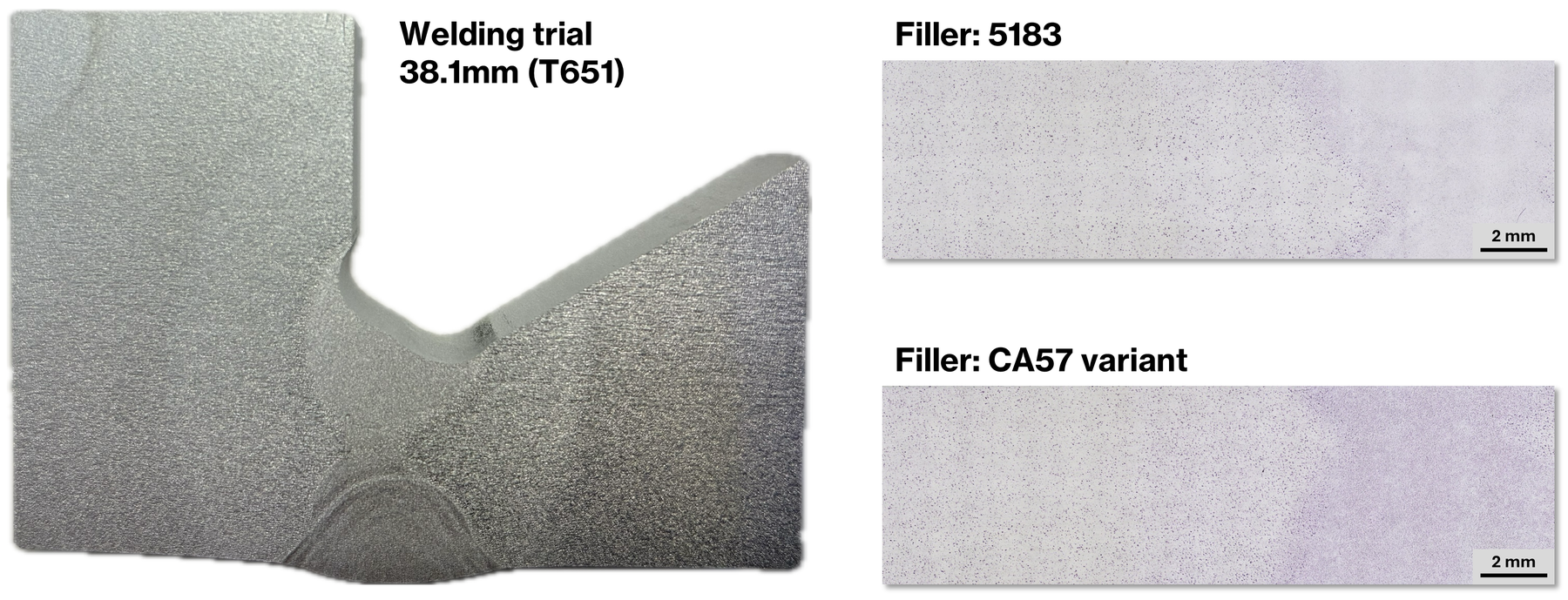
Weld macro section on 38.1 mm plate (T651) and micrographs of the fusion zone for 5183 filler and a CrossAlloy.57-based filler variant.
Physical Properties
| Property | min–max | mean |
|---|---|---|
| Density ρ (g/cm³) | 2.71–2.72 | 2.71 |
| Young's modulus E (GPa) | 70.3–73.0 | 71.7 |
| Shear modulus G (GPa) | 26.3–27.5 | 26.6 |
Potential use cases for CrossAlloy.57
Proposed applications are indicative and derived from cross-correlation between available material data and market research. They reflect where CrossAlloy.57 could add value from our perspective; given the limited information available to us, actual suitability is application-specific and is confirmed in cooperation with partners.
Armor / protective plate
CrossAlloy.57 as structural armor: high-strength plate that carries load while providing protection against armor-piercing and fragment threats, with the temper matched to plate thickness and threat class.
Protected vehicle structures
Weldable hull sections, hatches and appliqué panels where the armor also carries structural loads.
Security infrastructure
Protective claddings and barriers where weight, weldability and corrosion resistance matter alongside protection.
Available Dimensions
| Thickness | Max. width (mm) | Max. length (mm) |
|---|---|---|
| 6.0–12.0 mm | ||
| all Tx51 tempers | 1500 | 6000 |
| 12.0–150.0 mm | ||
| all Tx51 tempers | 1500 | 6500 |
Conservative assessment based on prototype production and limited number of lots. Additional dimensions available upon request.